


Chemical, Biological, Radiological, and Nuclear (CBRN) threats present a unique challenge: they are often invisible, fast-evolving, and potentially lethal at very low exposure levels. Protection against these hazards is therefore less about human reaction and more about automatic detection and response.
Modern protective shelters — whether civilian, industrial, medical, or defense-related — are increasingly designed as automated systems-of-systems, where CBRN sensors, control logic, and mechanical subsystems operate as a tightly coupled entity. When properly integrated, CBRN detection and shelter automation significantly enhance survivability by minimizing reaction time, reducing human error, and maintaining controlled internal conditions during a hazard event.
This article explores how CBRN detection technologies interface with automated shelter systems from a technical and architectural standpoint.
What Is the Role of CBRN Detection in Protective Infrastructure?
At a high level, CBRN detection systems perform three core functions:
- Sensing – Identifying the presence of hazardous agents or radiation.
- Assessment – Interpreting sensor signals to determine threat likelihood and severity.
- Triggering Response – Providing actionable signals to downstream systems.
Unlike traditional alarm systems, CBRN detection must operate continuously, discriminate between benign and hazardous stimuli, and function reliably in harsh or contaminated environments. This makes integration with automation systems critical.
What Threats Must Be Detected?
CBRN detection is typically implemented using multiple purpose-built sensors, as no single sensor can cover all threat classes effectively.
Chemical sensors must be able to detect those chemicals that have been identified as being a potential threat to the people in the shelter. This may include chemical warfare agents and various toxic industrial chemicals.
These sensors are typically deployed in air intake paths, external monitoring stations, or perimeter nodes to provide early warning before contaminants enter occupied spaces.
Biological detectors detect biological particles in the interesting size range from the input air. The sampling air must be raw outside air as a lot of the biological particles will be caught in the standard dust filters. A separate biological sample must be collected in case of alarm and studied further using standard laboratory procedures to confirm the presence of a biological threat.
Radiological sensors measure:
- Gamma and neutron radiation
- Dose rates and cumulative exposure indicators
Radiation detectors in shelters typically detect gamma and x-ray radiation and calculate dose based on measured dose rate.
These detectors are often designed for high reliability and long-term operation, as radiation events may persist longer than chemical hazards.
How Do Detection and Automation Work Together?
1. How Does Event-Driven Control Logic Operate?
When a CBRN detector signals a potential threat, the automation system does not simply “sound an alarm.” Instead, it executes predefined response sequences, often structured as state machines or rule-based logic. Typical automated actions include:
- Sealing external air intakes
- Switching HVAC systems from fresh-air mode to recirculation
- Activating overpressure systems to prevent infiltration
- Engaging filtration units (e.g., HEPA or multi-stage filters)
- Locking or sequencing access points
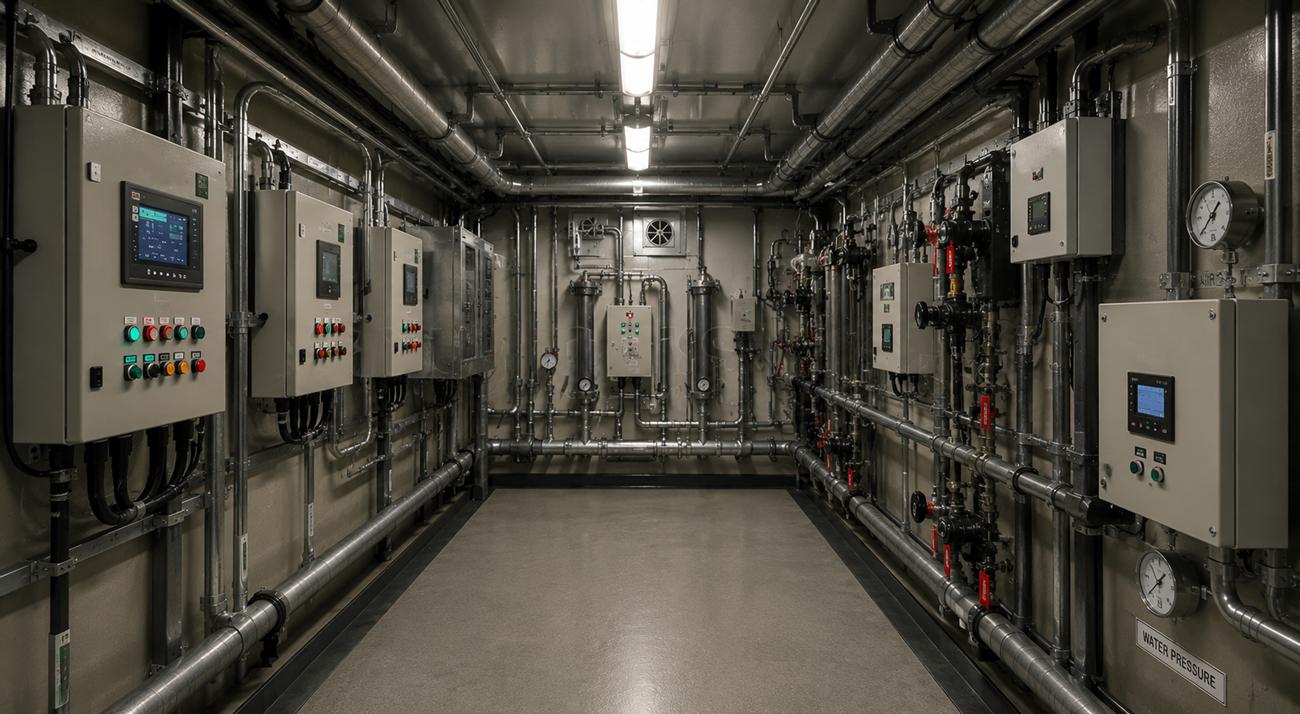
Example of a shelter automation equipment room. CBRN detectors deployed in strategic locations of the shelter send data to processing units in the automation room which trigger protective measures.
Because these actions are time-critical, automation ensures they happen within seconds, independent of human intervention. The operators have an override function that allows them to manually activate or deactivate controls when necessary.
2. How Does Shelter Pressurization and Airflow Control Work?
One of the most effective protective mechanisms is maintaining positive internal pressure. When combined with automated dampers and variable-speed fans, the shelter ensures that air leaks flow outward rather than inward, reducing contaminant ingress.
CBRN detection data feeds directly into airflow control algorithms, allowing the system to dynamically adjust pressure differentials based on threat duration and shelter occupancy.
3. How Is Adaptive Filtering Managed?
Modern shelters often incorporate intelligent filter management. Detection systems inform automation controllers about:
- Threat category (particulate vs. vapor vs. radiological)
- Estimated duration
- Contamination levels at intakes
Based on this information, the system can optimize filter usage, extend service life, and prioritize protection where it is most effective—all without exposing occupants to complexity.
How Is Human Interaction Maintained Without Human Dependence?
While shelter automation minimizes reliance on human reaction, it does not eliminate human oversight. Well-designed HMIs present clear system states, confidence levels, and manual override capability with safety interlocks.
This balance ensures that occupants and operators stay informed without being burdened by technical decision-making during high-stress events.
Conclusion
The true strength of modern CBRN protection lies not in individual sensors or mechanical components, but in their orchestration. By tightly integrating reliable CBRN detection with shelter automation, protective systems achieve rapid, consistent, and reliable responses to complex threats.
From a systems engineering perspective, this integration transforms shelters from passive structures into active defensive environments—capable of sensing danger, deciding intelligently, and acting decisively long before human intervention would be possible.
As detection technologies and automation platforms continue to evolve, their convergence will remain a cornerstone of effective CBRN protection.
Would you like to know more?

Download the Shelter CBRN Monitoring Application Note and gain access to exclusive content on X-System when used in shelters.
Leave a Reply