


Introduction
Naval vessels are designed to operate in some of the world’s most challenging environments. While traditional naval defence focuses on kinetic threats such as missiles, mines, and torpedoes, modern maritime operations increasingly require protection against a different class of hazards: chemical, biological, radiological, and nuclear (CBRN) threats.
Whether operating in contested waters, supporting humanitarian missions, protecting critical infrastructure, or responding to industrial accidents at sea, naval vessels must be capable of detecting invisible threats before they affect the crew, mission, or platform.
This is where integrated naval CBRN monitoring systems have become a critical component of modern ship design. Naval CBRN monitoring solutions provide continuous detection, early warning, situational awareness, and guidance capabilities that help crews maintain operational effectiveness even in contaminated environments. Our systems have been deployed across 160 vessels worldwide and are used by navies, coast guards, and maritime security organisations in more than 30 countries.
What Is Naval CBRN Monitoring?
Naval CBRN monitoring refers to the continuous detection and assessment of chemical, biological, radiological, and nuclear hazards aboard ships and maritime platforms.
Unlike portable detectors used during inspections or incident response, integrated naval systems are permanently installed throughout the vessel. They continuously monitor the environment around and within the ship, providing crews with immediate warning when hazardous substances are detected.
Modern systems combine multiple sensor types with command software to create a unified picture of the threat environment. Rather than simply generating alarms, they help operators understand the nature of a threat, assess its severity, and determine appropriate protective actions. This combination of detection and decision support has become increasingly important as naval vessels operate in more complex and unpredictable security environments.
Understand more about CBRN Monitoring in Naval & Maritime Vessels
Why Naval Vessels Need CBRN Protection
The maritime domain presents unique challenges when dealing with hazardous substances. Ships often operate far from support infrastructure, making self-sufficiency essential. If contamination occurs, the crew may have limited options for evacuation or immediate external assistance.
The primary objective of naval CBRN protection is simple: safeguard personnel and maintain the vessel’s ability to perform its mission. The key to achieving this is rapid detection and early warning. Every minute gained through early detection gives crews additional time to activate filtration systems, seal compartments, implement protective procedures, and avoid exposure.
This capability is particularly important because threats may originate from multiple sources. A vessel could encounter chemical warfare agents during military operations, radiation hazards near damaged infrastructure, biological contaminants in a crisis zone, or toxic industrial chemicals following an accident in a port or coastal facility.
Learn more on CBRN Threat Detection in Naval Warfare
Modern naval operations demand that ships remain effective under all these conditions. As a result, CBRN monitoring is increasingly viewed as a core survivability capability rather than a specialised add-on.
How Naval CBRN Monitoring Systems Work
A modern naval CBRN monitoring system is typically built around a networked architecture that combines multiple sensors, software platforms, and communication interfaces.
Sensors positioned throughout the vessel continuously sample the surrounding environment. These sensors may monitor external air, internal compartments, ventilation systems, and even surrounding water depending on the vessel’s requirements.
The collected data is transmitted to a central monitoring platform where information from multiple sensors is combined and analyzed. Operators receive alerts, visual displays, and recommended actions that help them respond quickly and effectively.
Bertin Environics’ X-System architecture is an example of this approach. The system integrates chemical, biological, and radiological detection technologies into a single monitoring framework while also providing situational awareness and guidance software.
One of the most important characteristics of modern naval systems is redundancy. The architecture is designed so that multiple components can continue operating even if one element fails, ensuring protection remains available throughout a mission.
Understand how to implement a CBRN Monitoring System into a naval vessel
The Importance of External and Internal Monitoring
Effective naval protection requires more than detecting hazards outside the vessel.
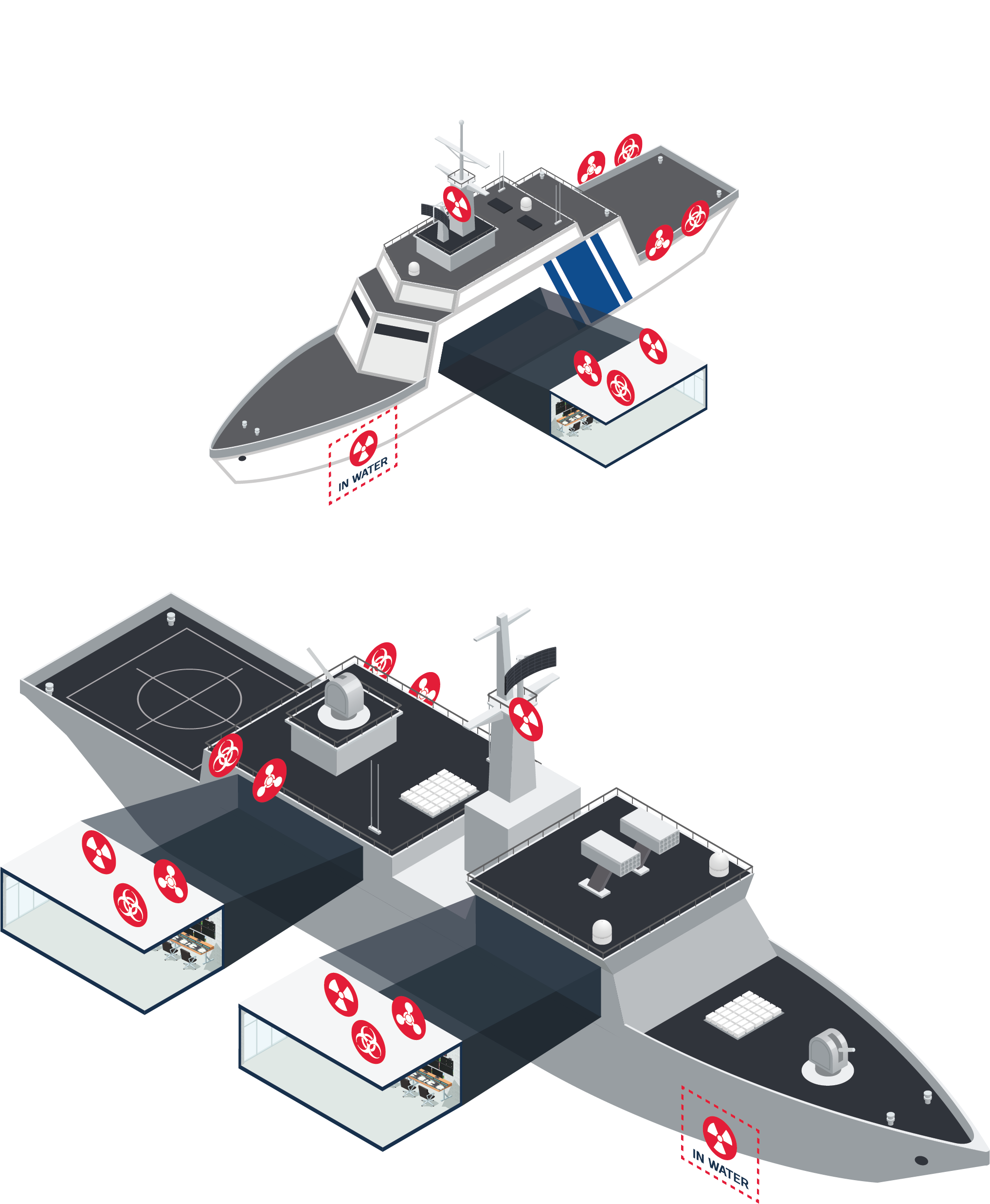
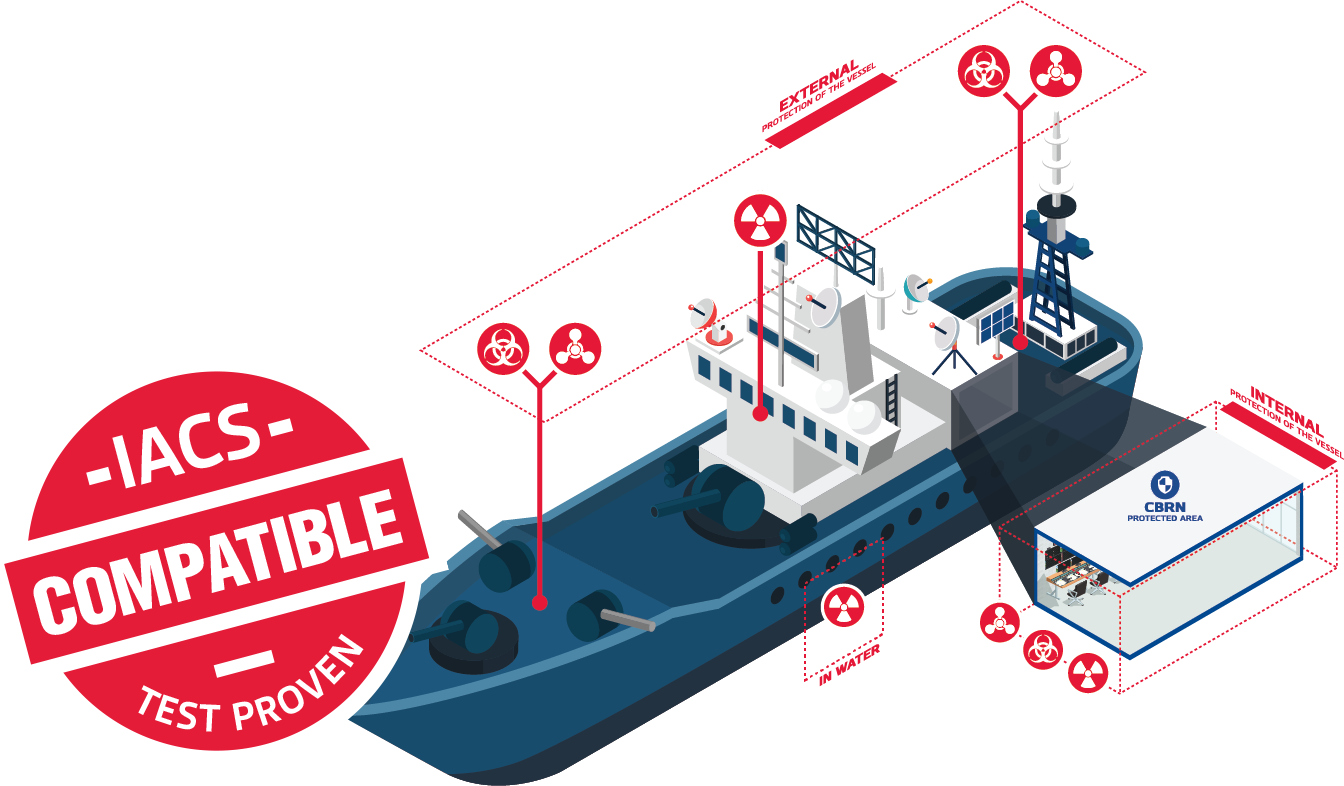
External monitoring provides early warning of threats approaching the ship. Detection points are often located on port and starboard sides, elevated mast locations, and other strategic positions that maximize coverage. Early warning allows the crew to activate protective measures before contamination enters the vessel.
However, once a vessel enters a contaminated area, internal monitoring becomes equally important. Crews need to know whether contaminants have entered protected spaces and whether filtration systems are performing as expected.
According to maritime protection guidelines, continuous monitoring of both external and internal conditions is essential for maintaining crew safety while operating within hazard zones.
This layered approach transforms the vessel into a self-monitoring platform capable of detecting, assessing, and responding to threats in real time.
Find out more on CBRN Monitoring Systems for Frigate Vessels
Key Technologies Behind Naval CBRN Protection
Naval monitoring systems rely on multiple specialised technologies working together.
Chemical detection systems monitor chemical warfare agents and toxic industrial chemicals. These detectors, such as ChemProX-DS, provide rapid warning and help crews distinguish between routine environmental conditions and genuine threats.
Biological monitoring detectors, such as BioScoutX, detect suspicious aerosols and biological hazards. While biological threats often develop more slowly than chemical incidents, early detection remains critical for containment and response planning.
Radiological monitoring detectors, such as RanidX, detect gamma radiation and radioactive materials that may indicate nuclear incidents, dirty bombs, or contamination events.
All of these technologies are linked through CBRN monitoring and control software. EnviScreenX platform provides sensor networking, alarm management, reporting, training capabilities, mission recording, and situational awareness tools from a single interface.
Vessel Types That Benefit from Naval CBRN Monitoring
One of the major advantages of modern CBRN architectures is their scalability.
Large combatants such as destroyers and frigates require comprehensive monitoring networks covering multiple compartments and operational areas. Offshore patrol vessels, corvettes, and missile boats typically need more compact but equally reliable solutions.
Find out more on CBRN Monitoring Systems for Frigate Vessels
Beyond military fleets, CBRN monitoring is increasingly used on coast guard vessels, rescue ships, pollution-control vessels, fire boats, and specialised surveillance platforms. These vessels are often among the first responders to maritime emergencies and may encounter hazardous materials before other assets arrive.
The same principles are also being applied to emerging unmanned surface vessels. As maritime autonomy expands, remotely operated and autonomous platforms are becoming valuable tools for investigating contaminated environments without exposing personnel to unnecessary risk.
Naval Integration and Shipbuilding Considerations
Successful integration requires collaboration between shipbuilders, naval architects, systems integrators, and CBRN specialists. Each vessel has unique operational requirements, physical constraints, and mission priorities.
According to Environics’ naval implementation guidance, successful projects begin with a shared understanding of operational objectives and continue through design, manufacturing, testing, installation, commissioning, training, and lifecycle support.
Modern naval programs increasingly favor modular architectures because they simplify upgrades and future expansion. This flexibility is particularly valuable given the long service lives of naval vessels, which often remain operational for several decades.
Compliance, Reliability, and Maritime Standards
Maritime environments are demanding. Equipment must withstand vibration, humidity, salt exposure, electromagnetic interference, and extreme weather conditions.
For this reason, naval monitoring systems are frequently designed to comply with maritime classification standards and recommendations from organisations such as the members of the International Association of Classification Societies (IACS).
Our naval monitoring solutions are designed around IACS recommendations and utilize components tested against IACS UR E10 requirements, helping ensure suitability for long-term deployment aboard ships.
These standards help ensure that monitoring systems remain operational when crews need them most.
Lear more on Classification Society’s Role in Naval CBRN Monitoring
The Future of Maritime CBRN Protection
Naval vessels are becoming increasingly connected, data-driven platforms. Future CBRN monitoring systems will likely play an even greater role in fleet-wide situational awareness. Instead of operating as isolated shipboard systems, sensors will increasingly contribute to shared operational pictures across task groups, maritime security networks, and joint military operations.
The rise of autonomous vessels, integrated ship management systems, and advanced decision-support software will further expand the role of CBRN monitoring.
As maritime threats continue to evolve, naval CBRN monitoring will become an increasingly important element of fleet survivability, operational resilience, and force protection.
Conclusion
Modern naval operations require more than firepower and physical protection. They require awareness.
CBRN monitoring systems provide that awareness by detecting invisible threats, delivering actionable intelligence, and enabling crews to respond before contamination affects personnel or mission success.
Through integrated sensor networks, situational awareness software, and scalable architectures, modern solutions allow naval vessels to operate confidently in environments where chemical, biological, and radiological hazards may be present.
The future of maritime protection lies in combining detection, intelligence, and automation into a single operational capability. For navies, coast guards, and maritime security organizations, CBRN monitoring is no longer a niche technology, it is becoming an essential component of modern vessel design and fleet readiness.
FAQs on Naval Vessel CBRN Monitoring Systems
What is a naval vessel CBRN monitoring system?
A naval vessel CBRN (Chemical, Biological, Radiological, and Nuclear) monitoring system is an integrated network of sensors, software, and alarm systems designed to detect hazardous substances aboard ships and in the surrounding environment. These systems continuously monitor for chemical warfare agents, toxic industrial chemicals, biological aerosols, and radiation threats, providing crews with early warning and actionable information. Modern naval CBRN monitoring solutions combine detection, situational awareness, and decision support to help vessels maintain operational capability in contaminated environments.
Why do naval vessels need CBRN monitoring systems?
Naval vessels often operate far from support infrastructure and may encounter a wide range of hazards, including military CBRN threats, industrial accidents, and environmental contamination. A CBRN monitoring system helps protect personnel, equipment, and mission effectiveness by providing early warning of invisible threats before exposure occurs. By enabling rapid activation of filtration systems, compartment isolation procedures, and other protective measures, these systems significantly improve crew survivability and operational resilience.
What types of ships can be equipped with naval CBRN monitoring systems?
Naval CBRN monitoring systems can be integrated into virtually any maritime platform. Common applications include frigates, corvettes, offshore patrol vessels, destroyers, coast guard vessels, mine countermeasure vessels, rescue ships, and specialized surveillance platforms. Modern modular architectures also allow these systems to be adapted for emerging unmanned surface vessels (USVs) and autonomous maritime platforms. The specific configuration depends on the vessel’s mission profile, size, and operational requirements.
How do naval CBRN monitoring systems contribute to situational awareness?
Beyond detecting threats, modern naval CBRN monitoring systems act as situational awareness tools. They collect data from multiple sensors throughout the vessel, analyze potential hazards, and present clear information to operators through centralized software platforms. This allows crews to understand the type, location, and severity of a threat in real time. Advanced systems can also share information with command-and-control networks, contributing to a broader operational picture across a fleet or task force.
What should shipbuilders and navies consider when selecting a naval CBRN monitoring system?
When evaluating a naval CBRN monitoring solution, decision-makers should consider detection capabilities, system reliability, integration flexibility, scalability, and compliance with maritime standards. The system should be capable of operating in harsh naval environments while integrating seamlessly with existing ship systems such as HVAC, filtration, combat management, and command-and-control networks. Long-term factors such as lifecycle support, upgradeability, training requirements, and compatibility with future technologies are also important considerations for maximizing operational value over the vessel’s service life.