


Introduction
Armoured vehicles have always been designed to withstand visible threats such as ballistics, blasts, and kinetic impact. But modern battlefields are increasingly defined by something far less visible: chemical, biological, radiological, and nuclear (CBRN) hazards. These threats don’t announce themselves, and by the time crews notice symptoms, it is often too late.
This is where integrated CBRN monitoring systems come into play. We focus on embedding detection and situational awareness capabilities directly into armoured platforms, transforming them from passive protective shells into active sensing nodes. Instead of merely surviving hostile environments, these vehicles can now interpret and respond to them in real time.
This guide explores how those systems work, why they matter, and how they are shaping the future of armoured mobility.
Understanding CBRN Monitoring in Armoured Vehicles
At its core, armoured vehicle CBRN monitoring is about awareness. It involves a network of detectors and software designed to detect hazardous substances in the environment and alert the crew before exposure occurs.
Unlike standalone handheld detectors, these systems are integrated into the vehicle itself. They continuously monitor the surrounding air and environment, detecting chemical warfare agents, toxic industrial chemicals, biological aerosols, and radiation. When a threat is detected, the system can trigger alerts, activate protective subsystems such as filtration or overpressure, and feed data into command networks.
Modern solutions are designed not just for detection but for decision support, helping crews understand what they are facing and what action to take.
Why CBRN Protection Has Become Essential
The importance of CBRN monitoring has grown alongside the changing nature of conflict. Threats are no longer limited to conventional warfare; they increasingly include asymmetric risks, industrial hazards, and hybrid scenarios.
One of the defining challenges is that CBRN agents are often invisible. A crew can unknowingly enter a contaminated zone without any immediate indication of danger. Early detection is critical in armoured vehicle operations because it allows crews to react before exposure occurs, rather than after.
There is also a broader operational dimension. Vehicles equipped with monitoring systems contribute data to a larger situational picture. This allows military units to map contaminated areas, anticipate hazard spread, and coordinate responses across formations.
How CBRN situational-awareness enhances guidance for Military Armoured Vehicles
In practical terms, this means CBRN monitoring is no longer just about protection, it is about maintaining operational tempo in environments that would otherwise force a halt.
How These Systems Are Built
Modern CBRN monitoring systems are typically modular, which makes them easier to integrate into a wide range of vehicles. Instead of a single monolithic device, they consist of multiple components working together as a unified system.
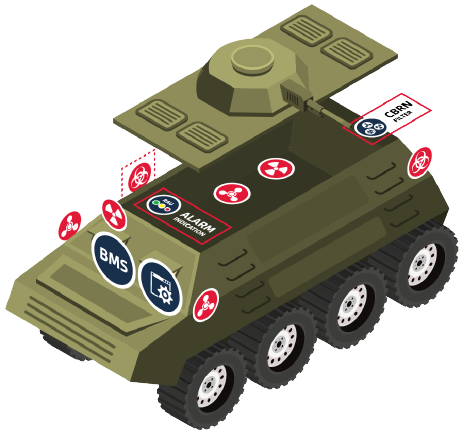
At the front end are the detectors. These detect chemical agents, radiation, or biological particles in the air. Behind them sits a processing layer that interprets the data, filters out false positives, and determines whether a real threat exists. The results are then communicated to the crew through user interfaces that prioritize clarity and speed: alerts must be immediate and unambiguous.
What makes these systems particularly valuable is their ability to integrate with other vehicle subsystems. For example, detection of a chemical threat can automatically trigger filtration systems or adjust internal pressure to prevent contaminants from entering the cabin.
It is important that system architectures are designed to be scalable and platform-independent, allowing the same core technology to be deployed across different vehicle classes.
Key Technologies Inside CBRN Monitoring Systems
Although the systems are integrated, it helps to understand the individual technologies involved.
Chemical detection is often the first line of defense, identifying both warfare agents and industrial toxins. Radiation detectors focus on gamma and X-ray emissions, which are critical in nuclear or radiological scenarios. Biological detection adds another layer, identifying airborne pathogens or suspicious bioaerosols.
What ties these together is software. Modern systems rely heavily on data fusion, combining inputs from multiple detectors to produce a clearer, more reliable picture. This reduces false alarms and ensures that alerts are meaningful rather than distracting.
X-System components are based on commercial off-the-shelf products, which speeds up deployment and simplifies maintenance.
Where These Systems Are Used
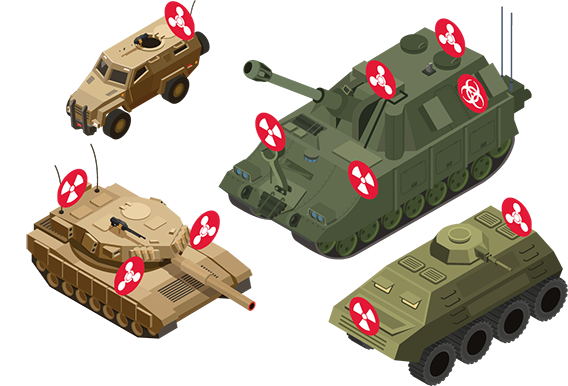
CBRN monitoring is not limited to one specific type of armoured vehicle. It is used across a broad spectrum, from heavy main battle tanks to lighter multirole vehicles.
The exact configuration depends on the mission. A reconnaissance vehicle might carry more advanced detection and identification capabilities, while a troop transport might prioritize early warning and automatic protection. The flexibility of modern systems allows them to be tailored without redesigning the entire vehicle.
That is the reason why adaptability is a key reason why modular approaches have become the industry standard.
Integration Challenges and Design Considerations
Integrating CBRN monitoring into an armoured vehicle is not trivial. Engineers must balance competing priorities such as weight, power consumption, and space—all while ensuring the system remains reliable under extreme conditions.
One of the main considerations is SWaP (size, weight, and power). Systems must be compact and efficient so they do not compromise the vehicle’s mobility or endurance. At the same time, they must be robust enough to operate in harsh environments, from deserts to arctic conditions.
Another challenge is interoperability. Modern vehicles are increasingly digital, with multiple subsystems sharing data. CBRN monitoring must fit seamlessly into this ecosystem, communicating with command-and-control systems and other onboard technologies.
Open and modular architectures are critical, as they allow systems to evolve without requiring complete redesigns.
LGet a better insight on how to implement X-System CBRN Monitoring Solution into Armoured Vehicles
Operational Impact
The real value of CBRN monitoring becomes clear in operational scenarios.
In combat, early detection can mean the difference between continuing a mission and aborting it. During reconnaissance, vehicles equipped with advanced detectors can map contamination zones, providing intelligence that benefits the entire unit. In peacekeeping or disaster response, the same systems can detect industrial hazards or environmental threats.
Across all these scenarios, the common thread is continuity. Instead of being forced to withdraw, units can adapt and continue operating safely.
The Future of Armoured Vehicle Protection
CBRN monitoring is increasingly being integrated into a broader ecosystem of vehicle protection and battlefield awareness. Armoured vehicles are evolving into networked platforms that combine multiple sensor systems, from active protection to electronic warfare.
One of the most significant trends is the shift toward data-centric operations. Vehicles are no longer isolated assets; they are nodes in a larger information network. CBRN data contributes to a shared understanding of the environment, improving decision-making at every level.
As highlighted in our integration-focused research, modularity and scalability will continue to drive innovation, enabling faster upgrades and better interoperability.
Understand the value of scalability and modularity during implementation process
Conclusion
Armoured vehicles are no longer just about armour and firepower. In today’s operational landscape, awareness is just as important as protection.
CBRN monitoring systems provide that awareness. They detect invisible threats, inform decision-making, and enable vehicles to operate in environments that would otherwise be inaccessible. By integrating these capabilities directly into the vehicle, manufacturers are redefining what it means to be protected on the battlefield.
As solutions like ours continue to evolve, the line between protection and intelligence will only become more blurred, turning armoured vehicles into fully aware, adaptive systems ready for the complexities of modern conflict.
FAQs on Armoured Vehicle CBRN Monitoring Systems
What is an armoured vehicle CBRN monitoring system and how does it work?
An armoured vehicle CBRN (Chemical, Biological, Radiological, and Nuclear) monitoring system is an integrated suite of detectors and software designed to detect, identify, and quantify hazardous agents in real time while the vehicle is in operation. These systems typically combine chemical detectors (e.g., ion mobility spectrometry), radiological detectors, and biological detection modules with onboard data fusion software. The system continuously samples the surrounding air, analyzes threat signatures, and provides immediate alerts to the crew. Advanced solutions also integrate with battlefield management systems (BMS) to share contamination data and enhance situational awareness across units.
Why is CBRN detection critical for armoured vehicles in modern military operations?
CBRN detection is essential because modern battlefields increasingly include asymmetric CBRN threats, including chemical agents, radiological dispersal devices, and industrial toxic hazards. Armoured vehicles operating without real-time monitoring risk exposing crews to invisible and potentially lethal contaminants. Integrated CBRN systems enable early warning, allowing crews to activate collective protection systems, adjust routes, and avoid contaminated zones. This capability directly supports mission continuity, force protection, and operational decision-making in contested environments.
What technologies are used in armoured vehicle CBRN monitoring systems?
Armoured vehicle CBRN monitoring systems typically employ a combination of detection technologies, including ion mobility spectrometry (IMS) for chemical warfare agents, orthogonal sensors for toxic industrial chemicals, Geiger-Mueller detectors for radiological threats, and elastic scattering sensors for biological hazards. These technologies are often supported by GPS-based mapping, automated sampling units, and data fusion algorithms. Modern systems emphasize modularity, allowing integration with vehicle electronics and communication networks for real-time threat reporting.
How do CBRN monitoring systems improve battlefield awareness and decision-making?
CBRN monitoring systems enhance battlefield awareness by providing continuous environmental intelligence. When integrated with command-and-control systems, they enable real-time mapping of contamination zones and threat propagation. This shared data allows commanders to make informed tactical decisions, such as rerouting units, deploying decontamination assets, or adjusting mission objectives. By transforming raw sensor data into actionable intelligence, these systems reduce uncertainty and improve operational effectiveness in hazardous environments.
What should be considered when selecting a CBRN monitoring system for armoured vehicles?
Key considerations include detection accuracy, response time, multi-threat capability, system integration, and environmental robustness. A suitable system should detect a wide range of chemical, biological, and radiological agents with minimal false alarms. It must integrate seamlessly with the vehicle’s power systems, communication infrastructure, and collective protection systems. Durability under extreme conditions — such as vibration, temperature fluctuations, and electromagnetic interference —i s also critical. Additionally, ease of maintenance, calibration requirements, and interoperability with allied systems should be evaluated to ensure long-term operational reliability.