


Introduction
Unmanned systems are increasingly being used to operate in environments where sending personnel would expose them to unnecessary risk. This is particularly important when chemical, biological, radiological, or nuclear (CBRN) hazards may be present.
Unmanned CBRN monitoring systems equip unmanned ground vehicles (UGVs), unmanned aerial vehicles (UAVs), unmanned surface vessels (USVs), and other robotic platforms with the ability to detect and monitor hazardous substances remotely. By moving CBRN sensors into potentially contaminated areas, these systems provide personnel with information about the threat environment without requiring them to enter the hazard zone.
Bertin Environics develops modular CBRN monitoring solutions for unmanned platforms that combine chemical, biological, and radiological detection with data management and situational awareness. The configuration can be adapted to the platform, mission, and required level of CBRN protection. The existing Unmanned CBRN Monitoring solution is designed to integrate with unmanned ground vehicles, surface vessels, and aerial drones.
What Is Unmanned CBRN Monitoring?
Unmanned CBRN monitoring is the use of remotely operated or autonomous platforms equipped with CBRN detection technologies to identify and monitor hazardous substances without exposing personnel directly to the threat.
Depending on the platform and mission, an unmanned CBRN monitoring system can detect chemical warfare agents, toxic industrial chemicals, biological aerosols, radioactive materials, or combinations of these threats.
The system typically combines CBRN detectors, data processing, communications, and a user interface. Measurements collected by the unmanned platform can be transmitted to operators or integrated into the platform’s existing data network, allowing personnel to assess the situation remotely.
This makes unmanned CBRN monitoring particularly valuable for reconnaissance, contaminated-area assessment, route investigation, incident response, and other missions where direct human access presents a significant risk.
Learn more about Unmanned CBRN Monitoring
Why Are CBRN Detection Capabilities Important for Unmanned Vehicles?
Unmanned vehicles can enter areas that may be unsafe or inaccessible for personnel. However, the platform itself needs sensors capable of identifying the hazards it encounters.
Without CBRN detection, an unmanned vehicle can provide information about physical surroundings while leaving the most important invisible threats undetected. Integrating CBRN sensors turns the platform into a remote sensing capability that can investigate potentially contaminated areas before personnel enter them.
Early detection can help operators determine whether an area is contaminated, identify the type of hazard present, establish safer routes, and support decisions about subsequent actions.
For military users, this capability can support CBRN reconnaissance and battlefield situational awareness. For civil protection and emergency response, it can help assess hazardous environments following industrial accidents, chemical releases, or other incidents.
How Do Unmanned CBRN Monitoring Systems Work?
An unmanned CBRN monitoring system combines sensors mounted on an unmanned platform with communications, data processing, and an operator interface.
During operation, the platform moves through or around an area of interest while its sensors continuously collect environmental measurements. Depending on the configuration, chemical detectors can identify chemical threats, biological detectors can monitor for suspicious bioaerosols, and radiological detectors can identify radioactive materials.
The collected information can then be processed and communicated to the operator or integrated into the unmanned vehicle’s existing data network. This provides remote personnel with information about the CBRN environment without requiring them to enter the area themselves.
X-System approach is modular, allowing the CBRN configuration to be adapted from chemical detection to a broader chemical, biological, radiological, and nuclear monitoring capability. ChemProX-DS can also function as an integration platform for additional detectors such as RanidX and BioScoutX in unmanned applications.
CBRN Monitoring for UGVs, UAVs and USVs
Different unmanned platforms provide different advantages for CBRN reconnaissance and monitoring.
Unmanned Ground Vehicles
UGVs can carry CBRN sensors into contaminated areas, buildings, restricted zones, or difficult terrain. They can be used to investigate potential contamination while keeping personnel outside the immediate hazard area.
Learn more on the role of Unmanned Ground Vehicles in CBRN Reconnaissance
Unmanned Aerial Vehicles
UAVs can provide a rapidly deployable means of surveying areas from the air. Depending on their configuration, drones can support CBRN reconnaissance over areas that are difficult or unsafe to access from the ground.
Learn more on Bertin Environics Solution for Chemical Reconnaissance
Unmanned Surface Vessels
USVs can perform CBRN monitoring in maritime environments while reducing the need to expose crews to potentially contaminated water or air. Bertin Environics’ USV solution is designed to integrate CBRN detectors into autonomous platforms and communicate measurement data with a mothership or other management system.
What CBRN Threats Can Unmanned Systems Detect?
The required detection capability depends on the mission and the level of CBRN protection required.
Chemical threats can include chemical warfare agents and toxic industrial chemicals. Chemical detection provides early warning when an unmanned platform encounters a potentially hazardous atmosphere.
Biological threats can be monitored through bioaerosol detection technologies. These capabilities can provide early indication of suspicious biological material for further assessment.
Radiological threats can be detected using radiation monitoring technologies capable of identifying elevated radiation levels and radioactive materials.
A modular architecture allows these capabilities to be combined into a single unmanned CBRN monitoring solution rather than requiring a separate platform for each threat type.
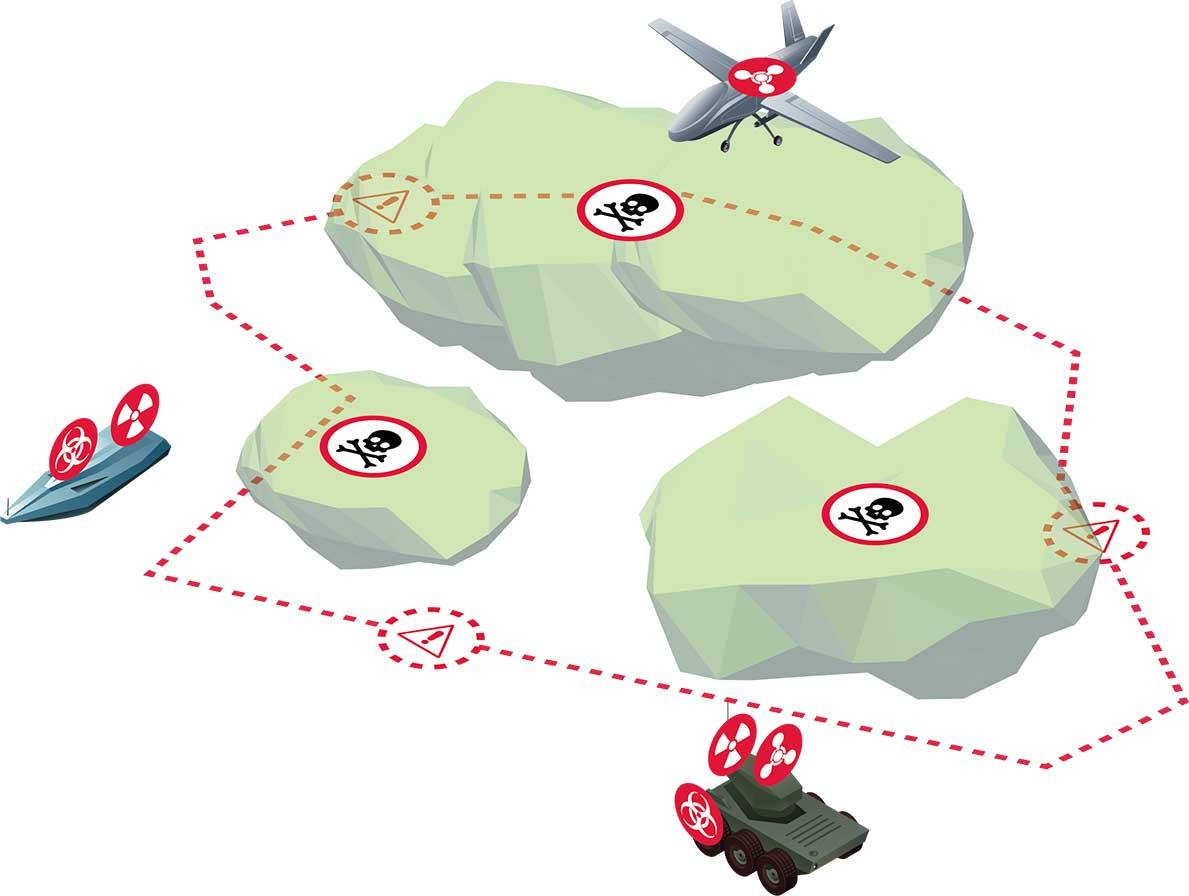
The system can be scaled according to the mission’s CBRN specific requirements.
Key Technologies for Unmanned CBRN Detection
A complete unmanned CBRN monitoring capability can combine several technologies:
Chemical detection for chemical warfare agents and toxic industrial chemicals
Biological detection for suspicious biological aerosols
Radiological detection for radioactive materials and radiation hazards
CBRN monitoring software for data visualization, alarm management, reporting, and situational awareness
Communications and data integration for transferring CBRN information between the unmanned platform and operator or command system
Bertin Environics’ portfolio includes ChemProX-DS, BioScoutX, RanidX and EnviScreenX, which can be configured according to application or mission requirements.
Benefits of Unmanned CBRN Monitoring
Reduced personnel exposure
Unmanned platforms can investigate potentially contaminated environments before personnel enter them.
Remote CBRN reconnaissance
Operators can obtain information about hazardous environments from a safer location.
Modular configuration
The CBRN capability can be scaled according to the mission, platform, and required threat coverage.
Increased situational awareness
Real-time sensor information provides operators with information about the CBRN environment and supports informed decision-making.
Platform-independent integration
CBRN sensors can be integrated into different unmanned platforms rather than requiring a dedicated vehicle design.
Mission flexibility
The same underlying CBRN architecture can support different missions, from chemical reconnaissance to comprehensive CBRN monitoring.
Integrating CBRN Monitoring into Unmanned Platforms
Integrating CBRN detection into an unmanned platform requires more than simply mounting a detector on the vehicle.
The system must account for available power, space, communications, environmental conditions, platform interfaces, sensor positioning, and the way measurement data will be presented to the operator.
An open and modular architecture makes it possible to adapt the CBRN system to different unmanned platforms while maintaining a consistent approach to detection and data management.
For military and security applications, integration with existing vehicle control, command-and-control, and data networks can further improve the value of CBRN information by making it available alongside other mission data.
The Future of Unmanned CBRN Reconnaissance
The development of autonomous and remotely operated platforms is changing how hazardous environments can be investigated.
As unmanned vehicles become more capable, CBRN detection can become an integrated part of their sensing architecture rather than a separate payload. This creates opportunities for autonomous CBRN reconnaissance, remote contamination mapping, coordinated unmanned operations, and greater integration with command-and-control systems.
The combination of robotics, CBRN sensors, communications, and situational-awareness software can extend the reach of CBRN detection while reducing the exposure of personnel.
Conclusion
Unmanned CBRN monitoring extends detection and situational awareness into environments where personnel may be at risk.
By integrating chemical, biological, and radiological detection technologies into UGVs, UAVs, USVs, and other robotic platforms, organisations can investigate hazardous areas remotely and obtain critical information before committing personnel.
A modular CBRN architecture allows the capability to be adapted to different unmanned platforms, missions, and threat environments. For defence, security, and emergency response applications, unmanned CBRN monitoring provides a practical way to combine remote operation with early warning and CBRN situational awareness.
FAQs on Unmanned CBRN Monitoring Systems
What is an unmanned CBRN monitoring system?
An unmanned CBRN monitoring system is a combination of chemical, biological, and radiological detectors, data processing, communications, and software integrated into an unmanned platform. It allows operators to monitor potential CBRN hazards remotely without exposing personnel directly to the contaminated area.
What types of unmanned vehicles can be equipped with CBRN detection?
CBRN detection systems can be integrated into unmanned ground vehicles (UGVs), unmanned aerial vehicles (UAVs), unmanned surface vessels (USVs), and other robotic platforms. The system configuration depends on the platform, mission requirements, environmental conditions, and required CBRN detection capability.
What CBRN threats can unmanned vehicles detect?
Depending on their configuration, unmanned CBRN monitoring systems can detect chemical threats, biological aerosols, and radiological hazards. Modular architectures allow different detector types to be combined to provide broader CBRN threat coverage.
Why use unmanned vehicles for CBRN reconnaissance?
Unmanned vehicles can investigate potentially contaminated environments without immediately exposing personnel to the hazard. They can provide information about the presence and location of CBRN threats, helping operators assess conditions and plan appropriate actions before personnel enter the area.
How are CBRN sensors integrated into unmanned platforms?
CBRN sensors are integrated according to the platform’s available power, space, communications, interfaces, and mission requirements. A modular architecture allows the sensors, data management, communications, and operator interface to be configured for different unmanned platforms and missions.