



Introduction
Critical infrastructure and strategically important facilities must remain operational even when exposed to unexpected hazards. Chemical, biological, radiological, and nuclear (CBRN) incidents can threaten personnel, disrupt operations, contaminate facilities, and create consequences that extend far beyond the initial release.
Critical infrastructure CBRN monitoring systems provide continuous detection and early warning to help organisations identify hazardous substances before they spread through protected areas or affect personnel.
Bertin Environics provides modular CBRN monitoring solutions for fixed and distributed applications, combining chemical, biological, and radiological detection with monitoring and control software. The existing Building CBRN Monitoring solution is designed around scalable, redundant architectures and can integrate sensors with third-party systems.
What Is Critical Infrastructure CBRN Monitoring?
Critical infrastructure CBRN monitoring is the continuous detection and assessment of chemical, biological, radiological, and nuclear hazards at important buildings, facilities, sites, and protected areas.
Unlike handheld detectors used by response personnel, fixed CBRN monitoring systems can continuously monitor predefined locations and provide early warning when a hazardous substance is detected.
Sensors can be positioned according to the site’s threat assessment and vulnerability analysis. Typical monitoring locations can include air intakes, entrances, reception areas, mail and cargo handling areas, conference rooms, rooftops, and other critical points within or around a facility.
The resulting information can be brought together through a central monitoring platform, providing operators with a unified view of the CBRN situation.
Why Does Critical Infrastructure Need CBRN Protection?
Critical facilities can be vulnerable to both deliberate and accidental CBRN incidents.
A chemical release, biological threat, radiological incident, or toxic industrial chemical leak can affect people, building systems, operations, and surrounding areas. In a facility that relies on ventilation and controlled access, an airborne contaminant can also spread through air-handling systems if it is not detected quickly.
Early detection provides the information needed to initiate appropriate protective measures. Depending on the facility and incident, these can include controlling access, managing ventilation, activating filtration, isolating areas, evacuating personnel, or initiating confirmatory procedures.
The objective is not simply to detect a substance. It is to provide enough information, early enough, to support an effective response while maintaining the continuity of critical operations.
How Do Critical Infrastructure CBRN Monitoring Systems Work?
A fixed CBRN monitoring system typically consists of strategically positioned detectors connected to a central monitoring and control platform.
Sensors continuously monitor selected areas or environmental pathways. When measurements indicate a potential threat, the system communicates the information to the monitoring platform, where operators can view alarms, measurements, system status, and other relevant information.
A complete system can combine chemical, biological, and radiological detection with software for situational awareness, reporting, training, maintenance, and system management.
EnviScreenX provides a browser-based interface for CBRN monitoring and control and can be used across critical infrastructure, distributed monitoring networks, shelters, vehicles, naval systems, and other applications.
Learn more on EnviScreenX, CBRN Monitoring & Control Software
Where Are CBRN Monitoring Systems Used in Critical Infrastructure?
CBRN monitoring requirements vary depending on the facility, threat environment, and operational role.
Critical Buildings
Government facilities, command centres, strategic buildings, and other protected facilities can use fixed CBRN detection to monitor entrances, air intakes, occupied areas, and other vulnerable locations.
Airports & Transport Infrastructure
Facilities with large numbers of people and complex ventilation systems can benefit from early detection of airborne chemical, biological, or radiological threats.
Industrial Facilities
Industrial sites may face both deliberate CBRN threats and accidental releases of toxic industrial chemicals. Monitoring can provide early warning of hazardous releases and support emergency response.
Shelters & Protected Facilities
Shelters can use CBRN monitoring to detect contamination entering protected areas and provide operators with information needed to manage the threat.
Borders & Entry Points
CBRN monitoring can support security at border crossings and other controlled entry points where hazardous substances may need to be detected.
Mass Events & Public Venues
Temporary or permanent monitoring systems can support CBRN protection at locations where large numbers of people gather.
These applications are reflected in Bertin Environics’ current application portfolio, which includes Building CBRN Monitoring, Shelter CBRN Monitoring, Mass Events CBRN Monitoring, and Border CBRN Monitoring.
What CBRN Threats Can Critical Infrastructure Monitoring Systems Detect?
A critical infrastructure monitoring system can be configured to address different combinations of CBRN threats.
Chemical detection provides warning of chemical warfare agents and toxic industrial chemicals.
Biological detection monitors for suspicious biological aerosols and can provide an early indication of a potential biological incident.
Radiological detection identifies elevated radiation and radioactive materials.
The appropriate combination depends on the facility’s threat assessment, vulnerability, operational requirements, and desired level of protection.
A modular architecture allows the detection capability to be scaled without requiring the entire monitoring system to be redesigned.
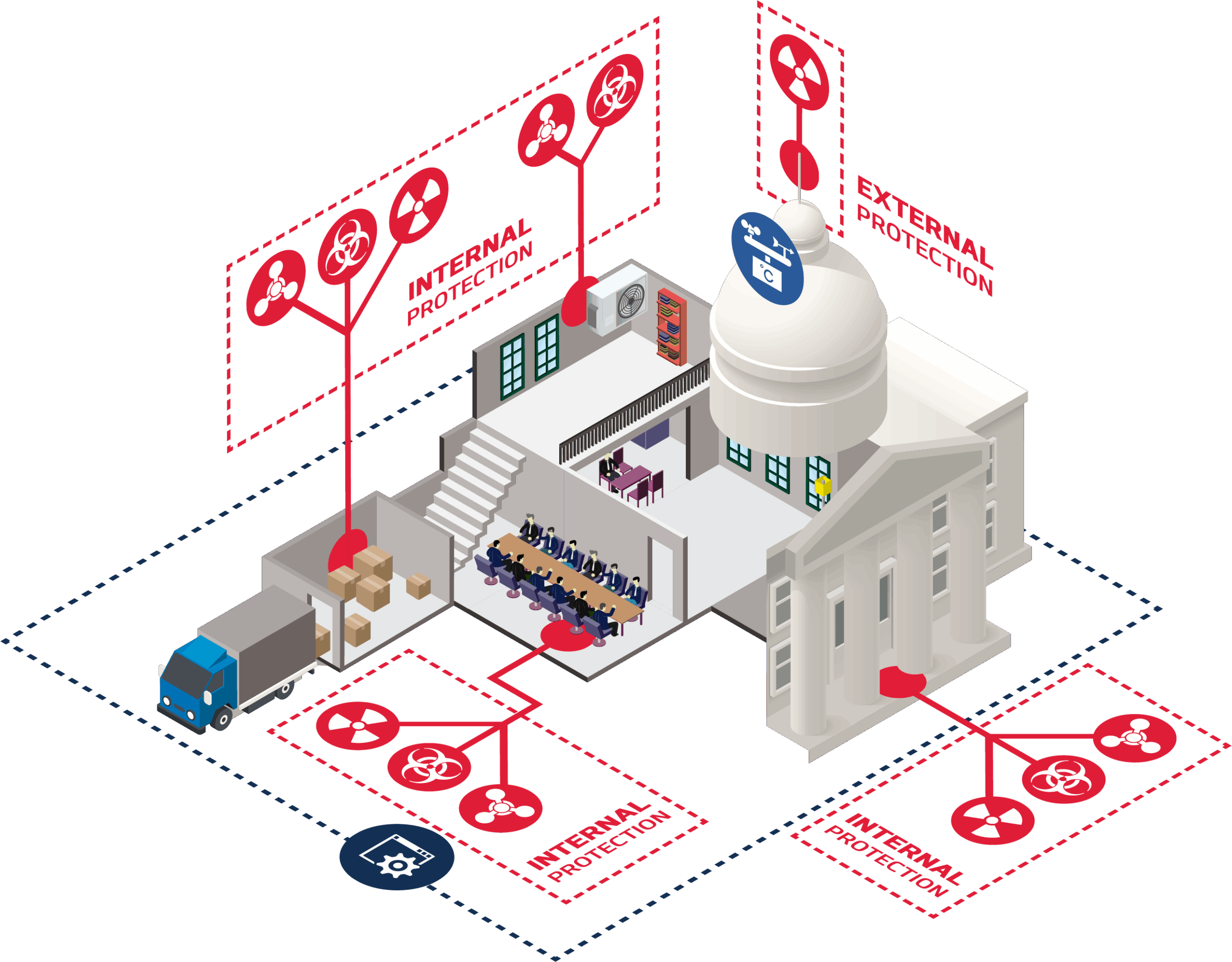
Building (CIP) standard scalable CBRN monitoring system.
Key Technologies Behind Critical Infrastructure CBRN Protection
An integrated critical infrastructure CBRN monitoring system can combine:
Chemical detectors for chemical warfare agents and toxic industrial chemicals
Biological detectors for continuous bioaerosol monitoring
Radiological detectors for radiation and radioactive material detection
Monitoring and control software for alarms, situational awareness, reporting and system management
Communications infrastructure connecting distributed sensors and monitoring stations
Third-party system interfaces for integration with building management, HVAC, security, and other facility systems
Bertin Environics’ current Building CBRN Monitoring solution specifically supports sensor and third-party system integration, while EnviScreenX provides a common software environment for monitoring, reporting, training, and maintenance.
Active and Passive CBRN Protection Strategies
Effective infrastructure protection can combine active and passive measures.
A passive strategy can establish protected areas and physical measures that limit the spread or entry of contaminants.
An active strategy uses sensors and monitoring systems to detect a threat and provide information that enables operators to respond.
The most effective architecture combines these approaches. Sensor locations are selected based on the site’s vulnerabilities and potential contamination pathways, while monitoring software provides operators with the information needed to understand and manage the situation.
This approach allows CBRN protection to be designed around the facility rather than treating detection as an isolated technology.
Benefits of Critical Infrastructure CBRN Monitoring
Continuous early warning
Fixed sensors can continuously monitor critical locations without relying on personnel to perform manual measurements.
Protection of people and facilities
Early detection provides valuable time to initiate appropriate protective and emergency procedures.
Improved situational awareness
Centralized monitoring provides operators with a unified view of measurements, alarms, and system status.
Scalable architecture
The system can be configured for a single facility or expanded across multiple monitoring locations.
Integration with existing systems
CBRN monitoring can exchange information with third-party systems and facility infrastructure.
Full lifecycle support
Modern CBRN monitoring systems can include maintenance, software updates, diagnostics, training, and reporting capabilities.
Designing a CBRN Monitoring System for Critical Infrastructure
There is no single CBRN monitoring configuration that fits every facility.
System design should begin with a threat, risk, and vulnerability assessment. This determines which areas require monitoring, which CBRN threats need to be detected, and how quickly operators need to receive warning.
Sensor placement is particularly important. Air intakes, entrances, cargo and mail handling areas, rooftops, and other vulnerable points may require dedicated monitoring depending on the site’s risk profile.
The system should also consider integration with existing building infrastructure, communications, security systems, HVAC and filtration systems, and command-and-control capabilities.
A modular architecture makes it possible to adapt the system as the facility’s requirements change.
CBRN Monitoring, Situational Awareness and Response
Detection is Only the First Part of CBRN Incident Management
Once a potential threat has been detected, operators need to understand where it was detected, how the situation is developing, which areas may be affected, and what actions should be considered.
This is where centralized CBRN monitoring software becomes important. EnviScreenX combines monitoring, situational awareness, reporting, training, and maintenance capabilities through a browser-based interface. It is designed to operate in isolated and air-gapped networks and supports open-standard data sharing for integration.
The result is a transition from isolated sensor alarms to a more complete CBRN situational-awareness capability.
The Future of Critical Infrastructure CBRN Protection
Critical infrastructure is becoming increasingly interconnected. Buildings, security systems, communication networks, environmental monitoring, and emergency management systems increasingly exchange information.
CBRN monitoring can become part of this wider security architecture by providing specialized information about chemical, biological, and radiological hazards.
Future systems will increasingly focus on distributed sensing, centralized situational awareness, interoperability, cybersecurity, and lifecycle management. This will allow organisations to move from isolated detection points toward coordinated CBRN monitoring networks covering multiple facilities and operational areas.
Conclusion
Critical infrastructure CBRN monitoring systems provide continuous awareness of chemical, biological, and radiological hazards at locations where an incident could have significant consequences.
By combining strategically positioned sensors, centralized monitoring software, communications, and integration with existing facility systems, organisations can detect threats earlier and respond more effectively.
The modular approach allows CBRN protection to be adapted to different facilities, threat environments, and operational requirements. From individual buildings and shelters to distributed infrastructure and large public sites, integrated CBRN monitoring helps protect people, maintain situational awareness, and support operational continuity.
FAQs on Critical Infrastructure CBRN Monitoring Systems
Why does critical infrastructure need CBRN monitoring?
Critical infrastructure can be exposed to chemical, biological, radiological, and toxic industrial hazards through deliberate attacks, industrial accidents, or other incidents. Continuous CBRN monitoring provides early warning, allowing operators to assess the situation and initiate appropriate protective measures before contamination spreads or affects more people.
Where should CBRN sensors be installed in a building?
Sensor locations should be determined through a threat, risk, and vulnerability assessment. Depending on the facility, monitoring points can include air intakes, entrances, rooftops, conference rooms, reception areas, and mail or cargo handling locations.
Can CBRN monitoring systems integrate with building management systems?
Yes. Modern CBRN monitoring architectures can provide interfaces for integration with third-party systems. Depending on the application, CBRN information can be integrated with building management, HVAC, filtration, security, communications, and command-and-control systems. Bertin Environics’ Building CBRN Monitoring solution supports sensor and third-party system-level integration.
Can a CBRN monitoring system cover multiple facilities?
Yes. A scalable architecture can support monitoring across multiple locations and distributed sensor networks. This allows organisations to build CBRN monitoring capabilities ranging from an individual building to larger networks of protected facilities.
What is the role of software in critical infrastructure CBRN monitoring?
CBRN monitoring software brings information from distributed detectors into a common operational view. It can provide alarm management, situational awareness, reporting, training, diagnostics, and maintenance capabilities. EnviScreenX is designed as a browser-based CBRN monitoring and control platform for applications including critical infrastructure and distributed monitoring networks.